
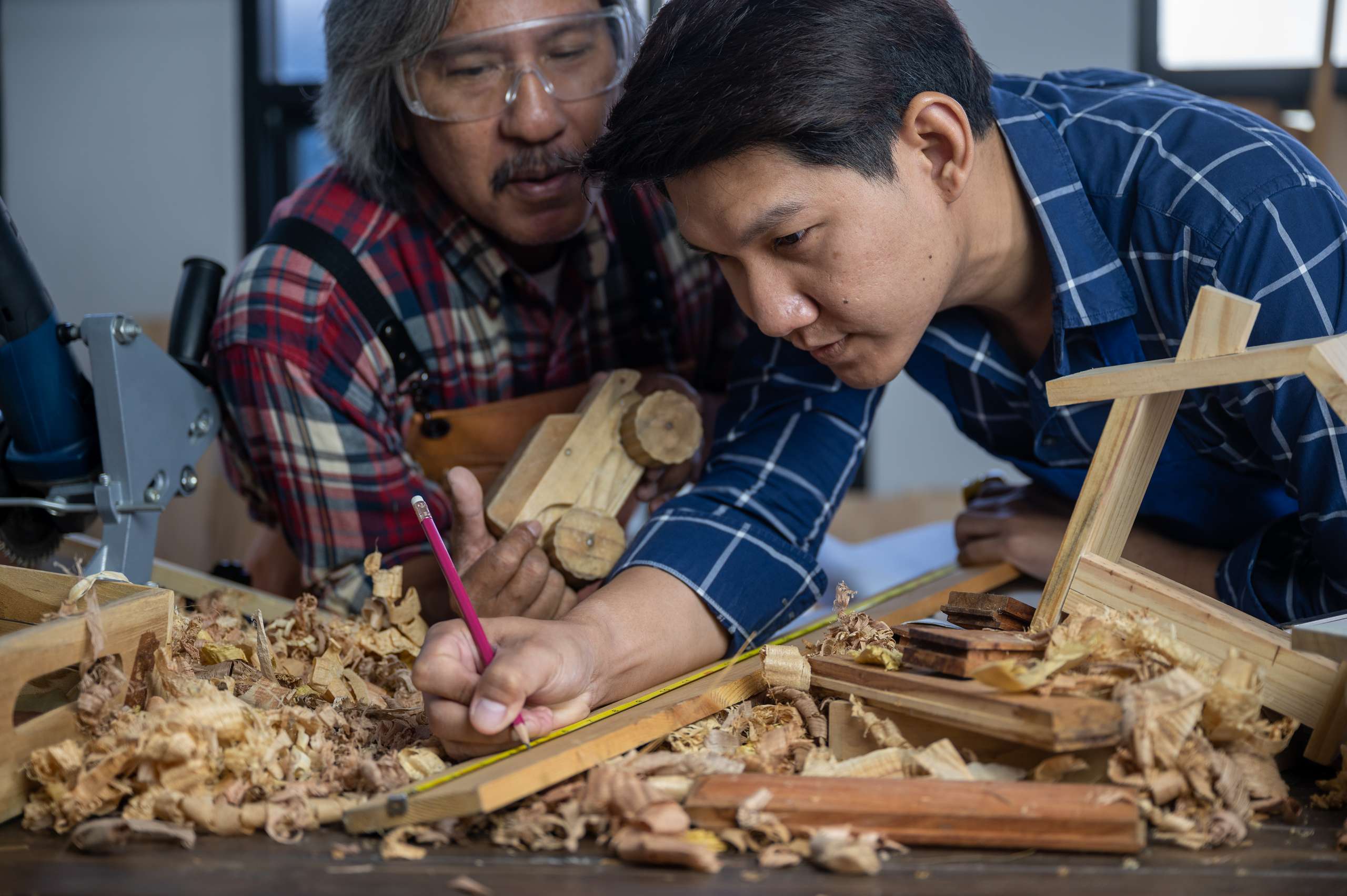
There will be a time when your improvement in a particular technique will start to grind to a halt, even though your time in the shop hasn’t. Your cuts aren’t perfectly square, your finishes aren’t perfectly smooth, and your projects aren’t looking any better than they did the last time you did them. You might feel like you’ve reached a physical limit, but in most cases, you’ve just reached a point where your techniques have become more habitual than mindful. Continuing to repeat your techniques mindlessly will only reinforce the issues that you have.
If this is the case, one of the best things you can do is slow down and do your techniques more mindfully. For instance, if you’re struggling with planing a board flat, try and do so at half the speed that you normally would. Pay attention to your stance, the plane’s angle, and the way that it sounds as you’re making the cut. You’ll notice slight differences as you plane at a slower speed, where you’re applying pressure, and how square you are. Many woodworkers are surprised to learn that their technique had gradually changed over time.
Sometimes, people can get to a point where they feel like they’ve stagnated and feel the need to move up to more advanced tools in the hopes that they will help improve their technique. Sure, a sharp blade and a square fence will help, but it won’t make up for a lack of control. In fact, sometimes moving down to a more primitive tool can help you improve your control, because you have to work harder to get it to do what you want. For example, if you’re having trouble with tear-out when using a power planer, try switching to a hand plane for a little while. It forces you to pay attention to the direction of the grain and how the plane is reacting to the surface of the wood, and you’ll probably find that your tear-out issues were happening because you weren’t paying attention to it when you were planing.
Doing a quick exercise can help you regain your momentum. Spend about 15 minutes doing a simple technique that you already know how to do perfectly, but focus on doing it right rather than doing it fast or a lot. After each stroke or cut, take a look at it in good light, and run your fingers over it to feel for any imperfections. This sort of instant feedback will keep you from going through the motions and will help you regain your intent for each stroke. If you find that you’re getting frustrated, it’s better to walk away for a few minutes rather than trying to power through with clenched fists.
As you do this, you’ll start to improve again, not because you’ve learned some new technique, but because you’re simply regaining your accuracy. You’ll get out of your rut and your confidence will come back because you’ll be able to anticipate the results of what you’re doing. Understanding that stagnation is a normal part of the learning process will help you to not get discouraged when it inevitably happens. Rather than treating it as a failure, you can treat it as an opportunity to slow down, pay attention, and rebuild from the bottom up.